
Exploring Web3 in a second-hand marketplace environment
🎖️ Project awarded a LAUS prize by ADG-FAD in the digital design category in 2024
Role:
Product Designer
Year:
2024
Duration:
4 months
Client:
Academic Thesis
What if buying second-hand felt not only convenient — but purposeful, transparent, and fully traceable? - Redo explores that possibility.
A conceptual marketplace for second-hand materials, powered by web3 technology, designed to bring blockchain-backed provenance, environmental storytelling, and shared ownership models to the circular economy.
[01] CONTEXT
Redo was developed as the final thesis project for the Master in UX & Digital Service Design at Elisava (Barcelona). The brief required creating a digital product aligned with at least three UN Sustainable Development Goals.
We identified a clear opportunity within the creative community: artists and design students frequently generate leftover materials but lack an efficient system to recirculate them. Redo addresses this gap through a web3-enabled second-hand marketplace where blockchain certifies the provenance and lifecycle of materials — giving users both physical and digital ownership while ensuring full traceability.
Beyond the academic scope, we explored a broader question: Can web3 become a real driver of change in future supply chains — beyond speculation and hype?
[02] ROLE
Redo was a collaborative project by Hannah Adib, Yenny Rong, and myself (Javier Serón). My role leaned heavily toward product strategy, technical research, and product definition:
▶
Product Definition — Defined a clear value proposition, product principles, competitive advantages, and key features, using trend analysis and future-thinking to shape an innovative marketplace concept.
▶
Web3 Research Lead — I drove all blockchain-related research: fundamentals, architecture, and emerging use cases, establishing the technology as a solid backbone for the product.
▶
Business & Viability Research — Led the market analysis and model definition, structured the Business Model Canvas, and created early financial projections for a hypothetical 2-year launch scenario.
[03] CHALLENGE
We anchored Redo in a real, observed problem within Elisava: the high volume of material waste generated through prototype fabrication, combined with the absence of systems to recirculate these materials.
From there, we expanded the challenge: How might we integrate web3 technologies into everyday digital products without overwhelming users? What friction does web3 introduce? Where does it add real value?
_MAIN CHALLENGES:
▶
Innovation vs. Adoption — Pushing technological innovation without compromising usability or accessibility.
▶
Sustainable Digital Product — Designing a solution that meets at least three UN SDGs while remaining viable and user-centric.
▶
Everyday Disruption — Exploring how emerging technologies could improve existing behaviors in simple, non-intimidating ways.
[04] GOALS
Translated into concrete product goals:
▶
Encourage recycling
Enable users to buy and sell leftover materials, reducing waste and promoting circular practices.
▶
Promote sustainable creativity
Support artists and designers in adopting recycled materials through a more transparent ecosystem.
▶
Reduce waste
Give unused materials a second life, preventing them from ending up in landfills.
▶
Enhance traceability
Provide blockchain-verified provenance to build trust in material quality and origin.
[05] PRODUCT DESIGN
Every design decision began with validation. Before shaping a solution, we focused on understanding real needs and behaviors within the university ecosystem.
USERS INSIGHTS
▶
Excess material is a universal pattern
90% of students generate leftover materials after projects.
▶
Strong intent to recirculate, but no channel
90% are willing to sell or exchange materials, but lack tools to do so.
▶
Sustainability is valued, but convenience wins
Sustainability is valued, but convenience wins → 80% appreciate sustainable practices, yet prioritize price and ease of purchase.
▶
Structural problem, not just individual
Structural problem, not just individual → The workshop manager confirmed the absence of any system capable of managing the university’s material waste at scale.
TRENDS SEEKING
Future-facing trend analysis was a core pillar of the project. Redo’s product strategy and feature definition were heavily shaped by understanding where digital behavior, ownership models and sustainability practices are heading. The goal was to design with a disruptive, near-future lens — without crossing into speculative design.
Key trends that informed the product:
▶
Collaborative Economy
People increasingly value belonging and participation over transactional relationships.
▶
Digital Currencies
The rise of crypto and alternative payment systems reshapes expectations around digital value.
▶
New Business Models
Users gravitate toward participatory, community-driven ecosystems that foster engagement.
▶
Zero-Waste Mindset
Growing environmental awareness drives demand for reuse-first solutions.
▶
Blockchain & Decentralization
As Web2 models lose trust, users seek transparency, ownership, and autonomy.
▶
Radical Transparency
Consumers expect clarity in supply chains, product origins, and digital interactions.
▶
Second-Life Consumption
Economic pressure and environmental responsibility accelerate the adoption of reuse and recycling as everyday behaviors.
This trend landscape allowed us to position Redo in a relevant, emerging space where circularity, transparency, and digital ownership intersect.
_VALUE PROPOSITION
A marketplace for recycled materials that helps the art and design community reduce waste and verify sustainable provenance.
Built using the Value Proposition Canvas to synthesize user segments, pains, gains, and functional needs.
PRODUCT_PRINCIPLES
To maintain coherence during the design process, we defined four foundational principles:
▶
Make technology invisible
Technology should operate in the background, not become a barrier to adoption.
▶
Guarantee transparency
Provenance and lifecycle data must be accessible, verifiable, and trustworthy.
▶
Secure origin
Certification is core; users should know exactly where materials come from.
▶
Users own the asset
Users hold both the physical material and its digital representation, reinforcing trust and long-term value.
These principles served as our north star — ensuring alignment between technology, user needs, and product purpose.
FINAL HYPOTHESES
A core part of Redo’s product strategy was built around a set of foundational hypotheses — questions that shaped how we could deliver a truly disruptive, trust-driven marketplace experience:
▶
How do we guarantee transparency across asset exchanges within the platform?
▶
How do we ensure end-to-end traceability of every material?
▶
How do we certify the authenticity and sustainable provenance of each asset?
In other words:
What underlying technology can operationalize transparency, traceability, and authenticity as first-class product features? Positioning Redo as a web3-native product and leveraging blockchain as its trust infrastructure.
[06] SOLUTION
In digital product design, the “solution” often gets reduced to a set of polished screens — a mobile app, a website, a flow. But Redo was different for me. This project allowed me to step outside the traditional boundaries of UX and focus on something far more fundamental: the technological architecture that makes the product viable.
Yes, I designed interfaces. But my core contribution — and where I played a leading role — was in defining the system that powers Redo under the hood: a decentralized trust layer built on web3.
Rather than treating blockchain as a feature, we treated it as the backbone of the product, enabling ownership, transparency, and material traceability in ways that conventional Web2 systems simply cannot.
This section focuses on that solution: how we transformed abstract hypotheses around trust and provenance into a scalable, verifiable, blockchain-powered product foundation.
PRODUCT ARCHITECTURE
Redo is built on a Web3-first architecture where each layer plays a distinct role: the Web3 ecosystem provides decentralized trust primitives; Ethereum anchors authenticity and ownership; Polygon delivers scalable, low-cost transactions; and the product layer transforms this infrastructure into a seamless user experience where blockchain becomes invisible.
This layered architecture is what allows Redo to merge sustainability, traceability and digital ownership into a single, cohesive ecosystem.
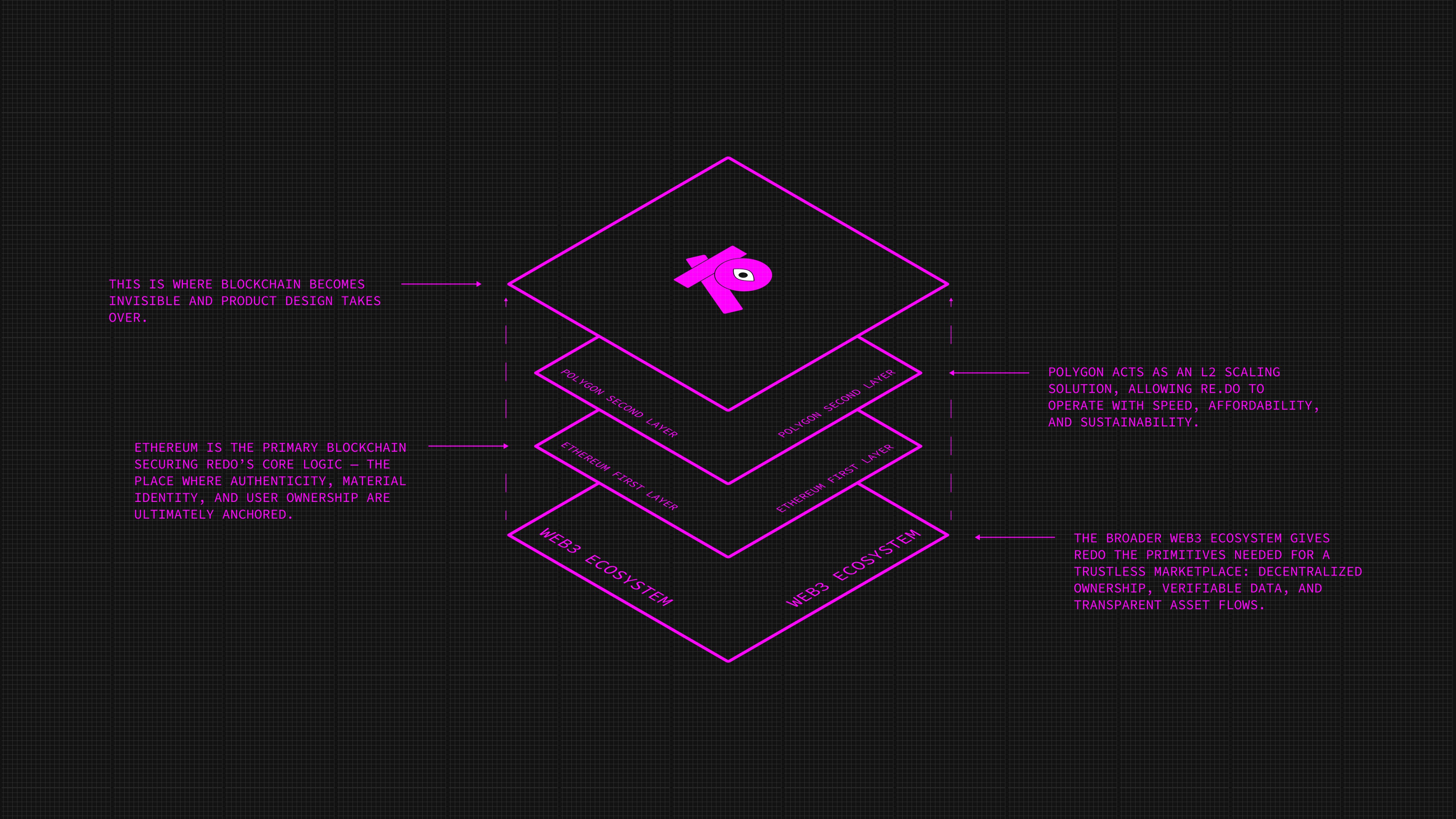
↳ This diagram visualizes Redo’s Web3 architecture as a layered system: a decentralized trust foundation, a secure Ethereum base, a scalable Polygon execution layer, and a product layer that abstracts all complexity into a seamless user experience. Together, these layers enable verifiable provenance, transparent material flows, and true digital ownership.
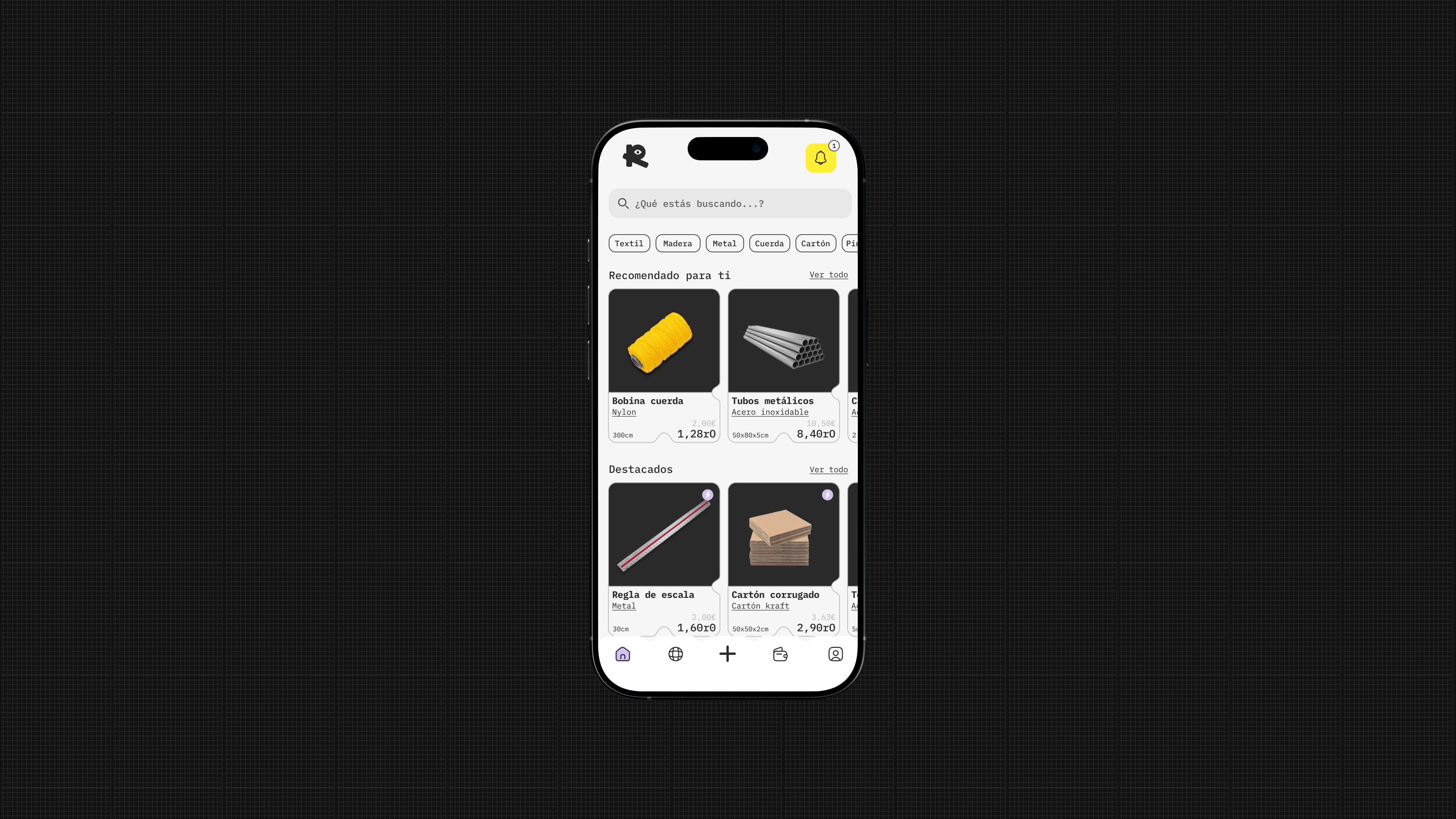
↳ This interface shows how Re.do’s product architecture surfaces on-chain infrastructure through a familiar, user-friendly marketplace. While blockchain handles identity, certification and provenance in the background, the UI delivers a seamless browsing experience where materials are discoverable, traceable and ready for circular reuse.
ON-CHAIN SALES SYSTEM
At the core of Re.do’s marketplace is an on-chain sales system that transforms each material listing into a verifiable, trustless exchange between seller and buyer. Instead of replicating a traditional Web2 transaction flow, we designed a hybrid Web2/Web3 model where blockchain handles trust and certification, while the product ensures seamless usability.
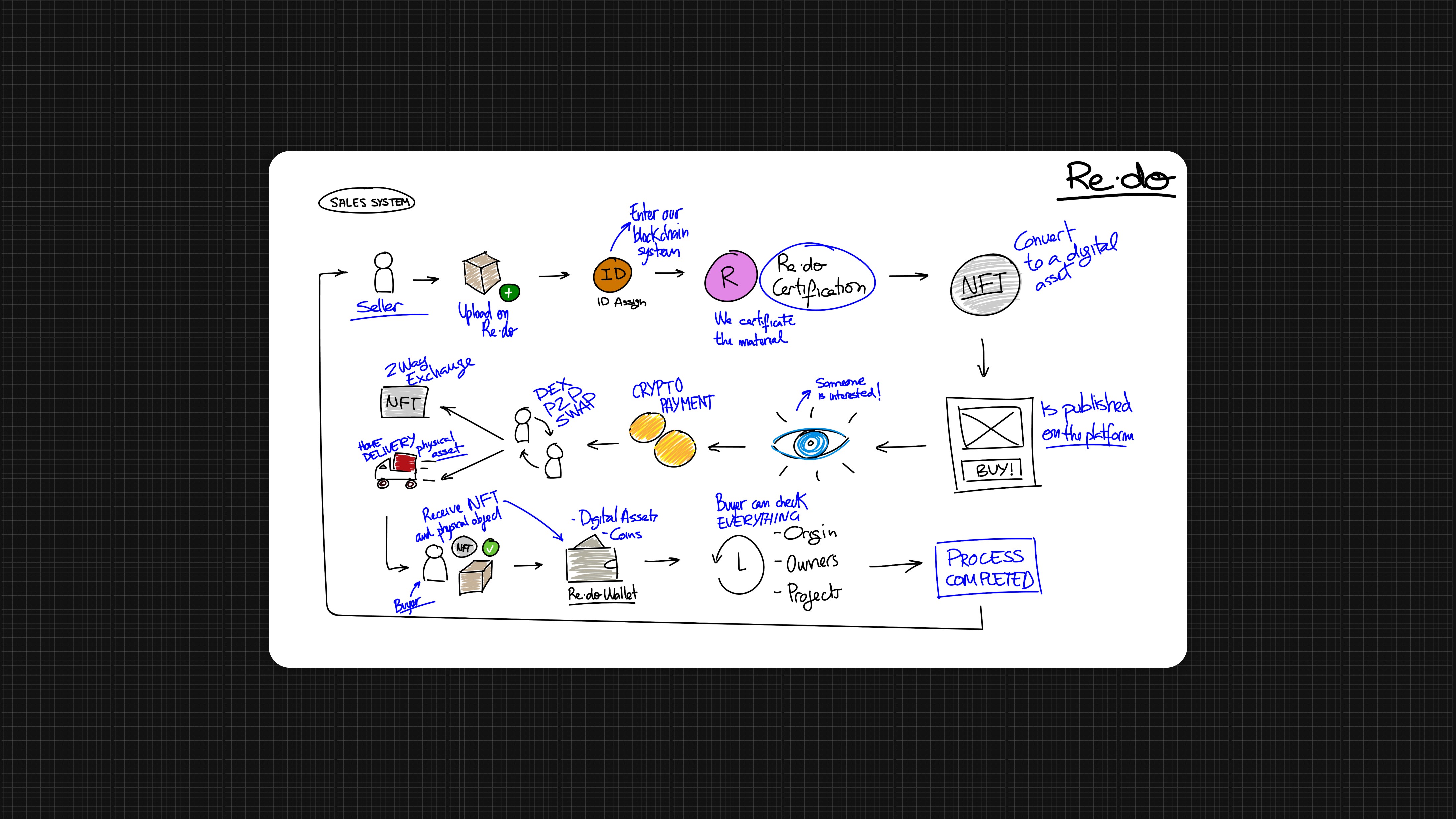
↳ This early sketch of our sales system — drafted during the product definition phase — became the blueprint for Redo’s on-chain transaction flow. It allowed us to map how certification, tokenized ownership, crypto payments and atomic swaps converge into a seamless user experience. This visual framework guided the design of a transparent, trustless Web3 marketplace and informed the architecture behind Redo’s decentralized sales ecosystem.
DESCENTRALIZED PAYMENT LAYER
To support trustless transactions and reduce friction in the buying experience, Redo introduces r0in (r0) — a native, Ethereum-based token designed specifically for circular commerce.
Traditional Web2 payments introduce intermediaries, fees, waiting times and a lack of transparency. In a Web3 marketplace where every material has an on-chain identity, payment also needs to be instant, verifiable and aligned with decentralized ownership.
r0in solves this.
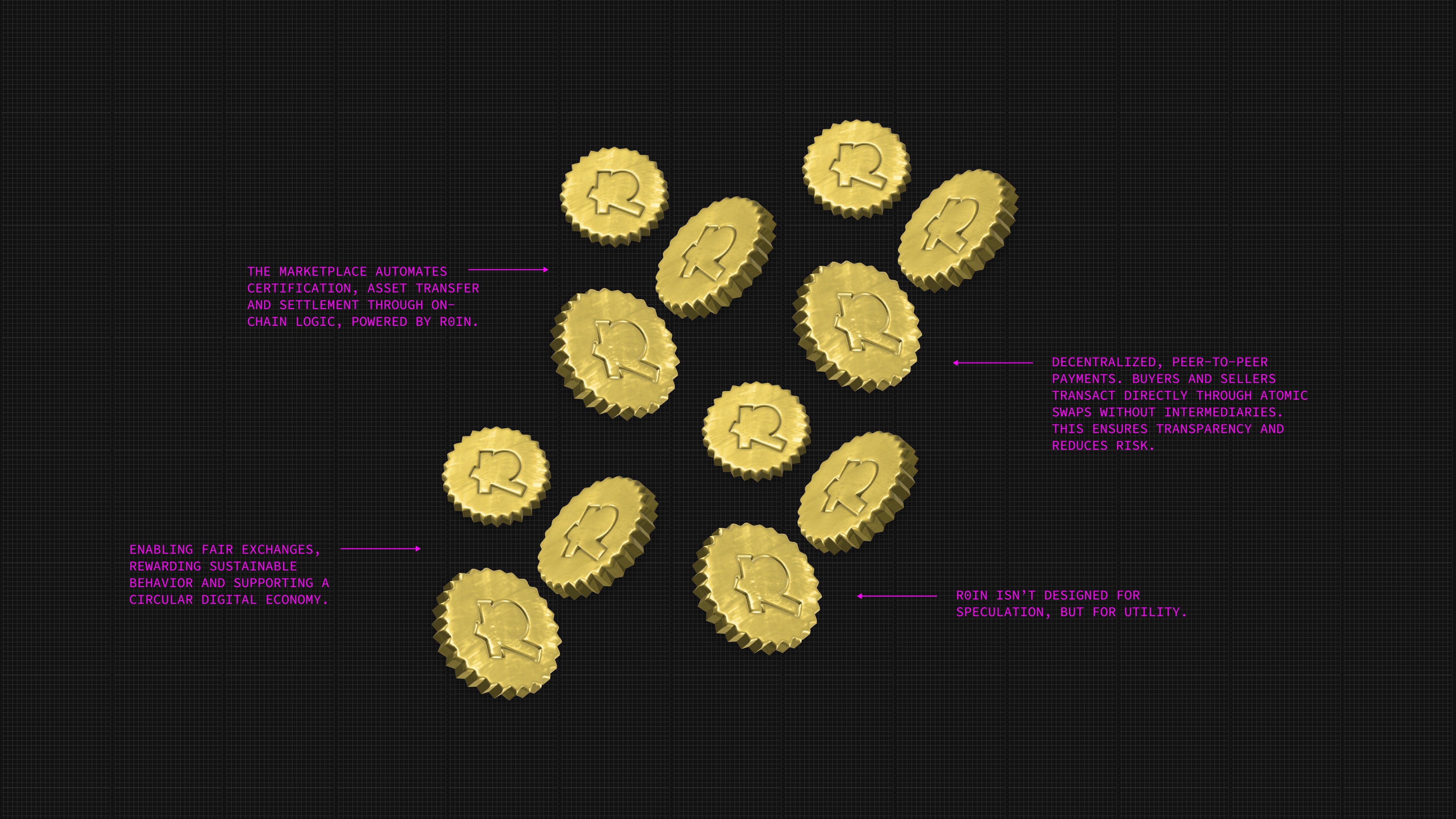
↳ r0in powers Redo’s decentralized payment layer, enabling trustless, peer-to-peer transactions, automated certification and asset transfer, and a circular economy where value flows transparently between users.
TRACEABILITY & CERTIFICATION
A core part of Redo’s value proposition is the ability to verify the full lifecycle of every material published in the marketplace. In the context of Web3, traceability means more than tracking a transaction — it means anchoring the entire history of an asset in a decentralized, transparent and tamper-proof environment.
Using blockchain, every material in Redo becomes a verifiable digital asset whose origin, ownership changes and project usage can be tracked from start to finish. This allows us to guarantee that materials listed on the platform are genuinely recycled, reused and authenticated.
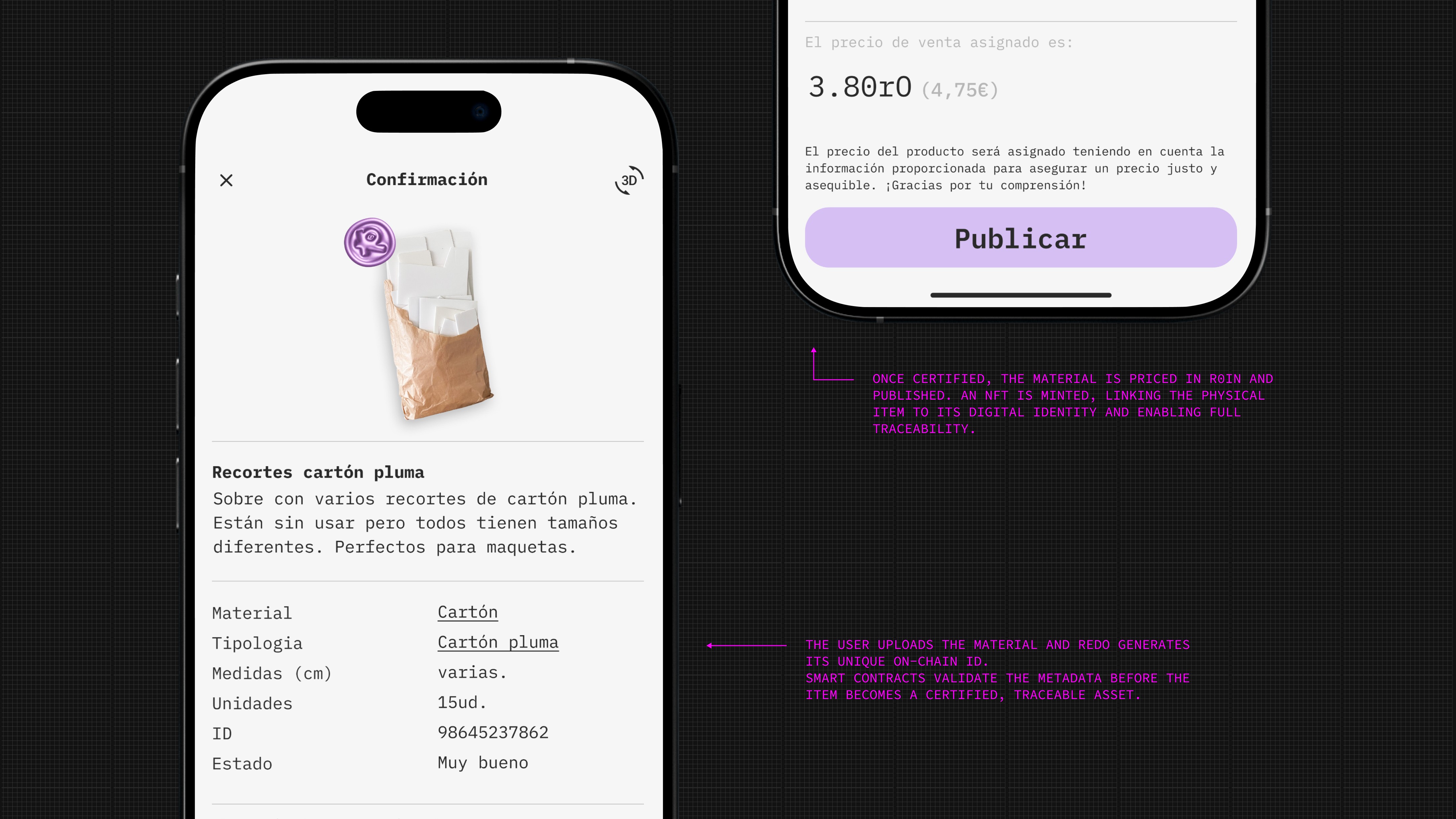
↳ Traceability & Certification begins at upload: Re.do generates a unique on-chain ID and validates the material through smart-contract certification, ensuring it becomes a transparent and verifiable digital asset before entering the marketplace.
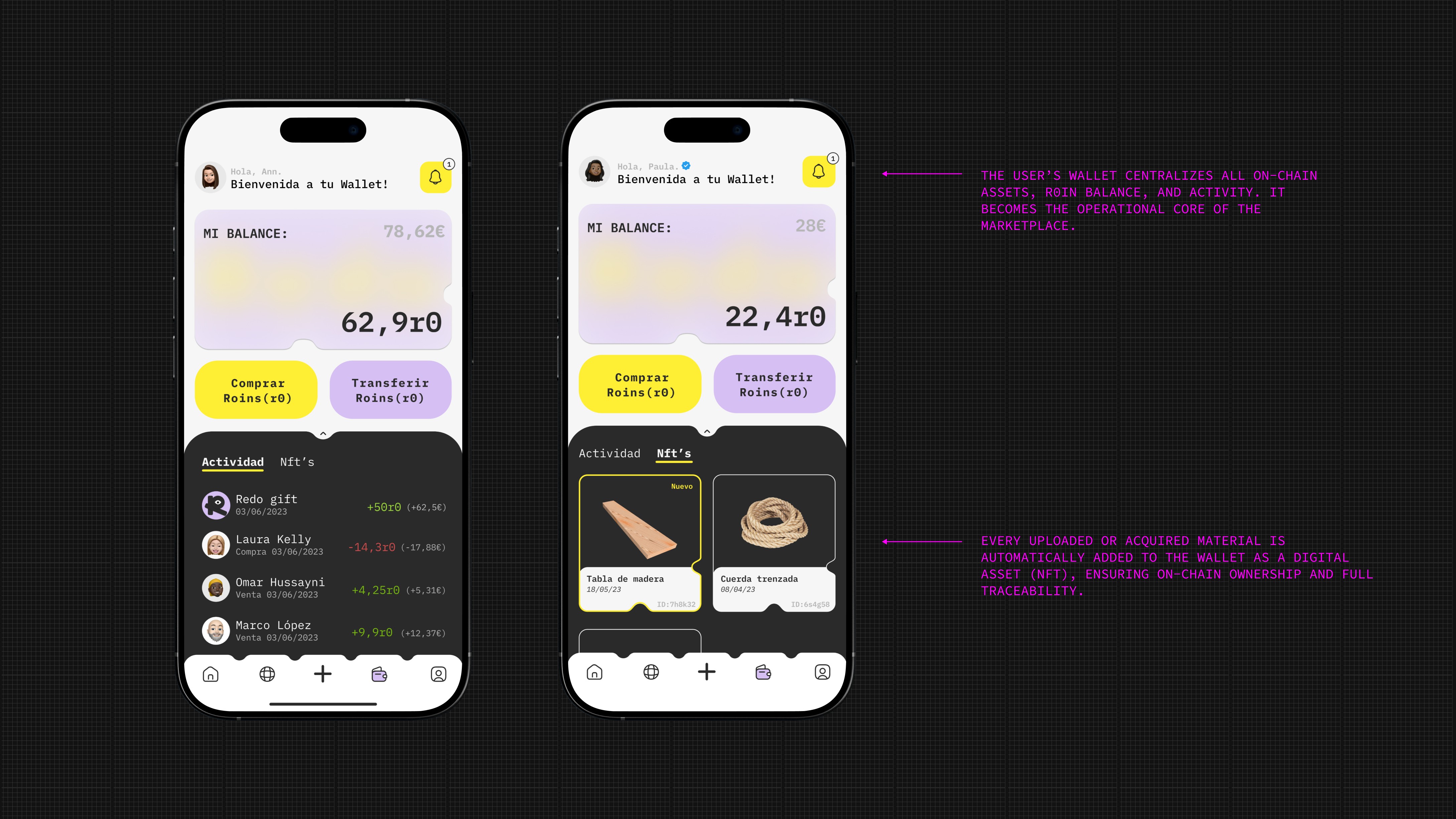
↳ Traceability & Certification extends to the wallet: each user’s wallet centralizes on-chain assets, r0in balance and transaction activity, ensuring full visibility. Every acquired material becomes a digital asset (NFT) that secures ownership and lifecycle traceability.
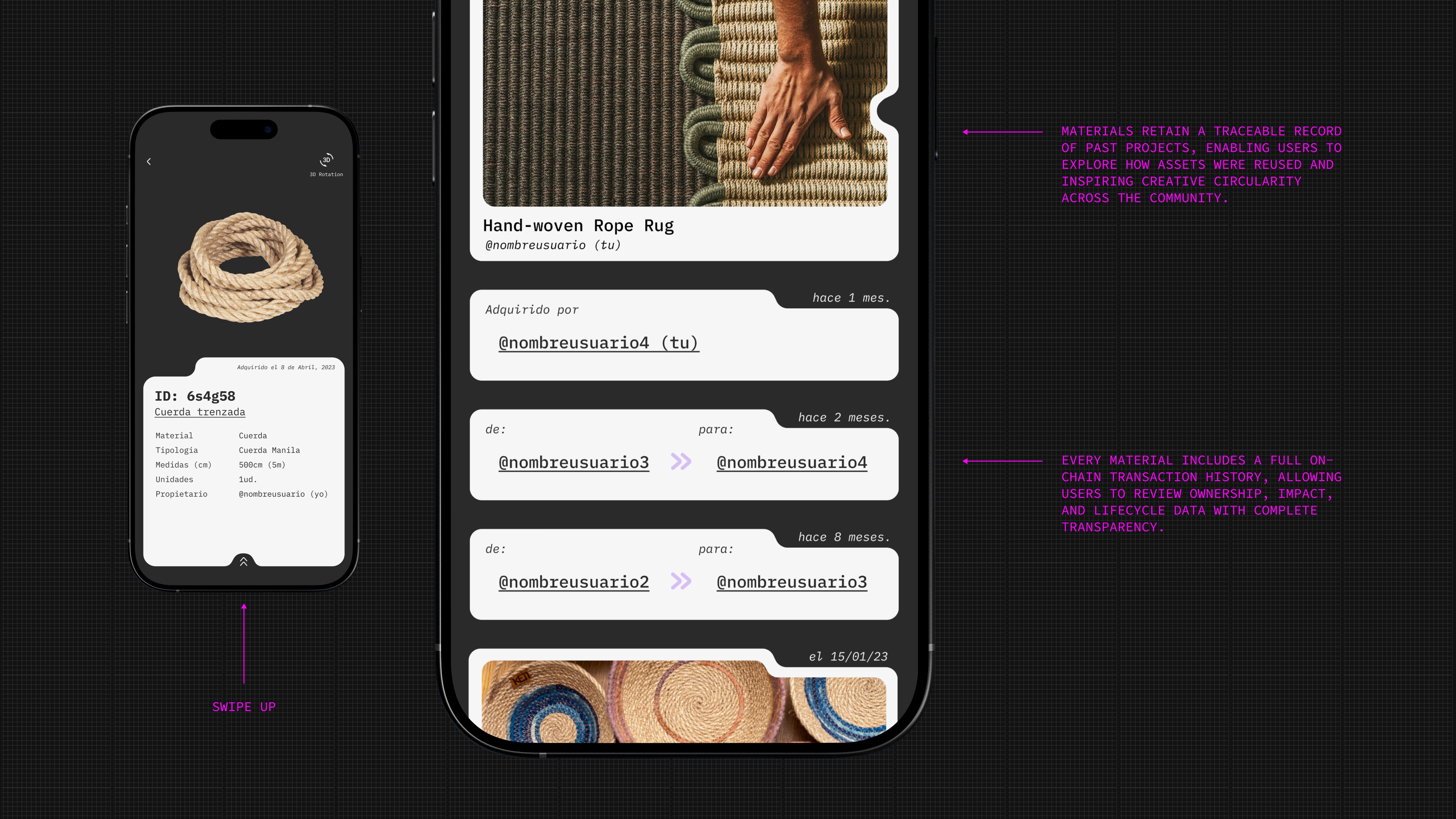
↳ Traceability & Certification enables complete provenance: materials retain an immutable history of ownership, transfers and project impact. Users can explore the full on-chain lifecycle of any asset with complete transparency.
COMMITTED COMMUNITY
Beyond its technical architecture, Redo is designed to become a cultural catalyst — a platform where designers, makers, and students can stand out not only for what they create, but for how they create it. Re.do positions sustainability as a visible, verifiable and shareable layer of a designer’s identity.
While the marketplace enables transparent material exchange, the community layer turns those transactions into collective impact. Every certified material, every verified project and every traceable lifecycle contributes to a shared ecosystem that celebrates responsible creativity.
By merging blockchain infrastructure with community-driven incentives, Redo encourages a new generation of designers to adopt sustainability not as a trend, but as a core creative principle.
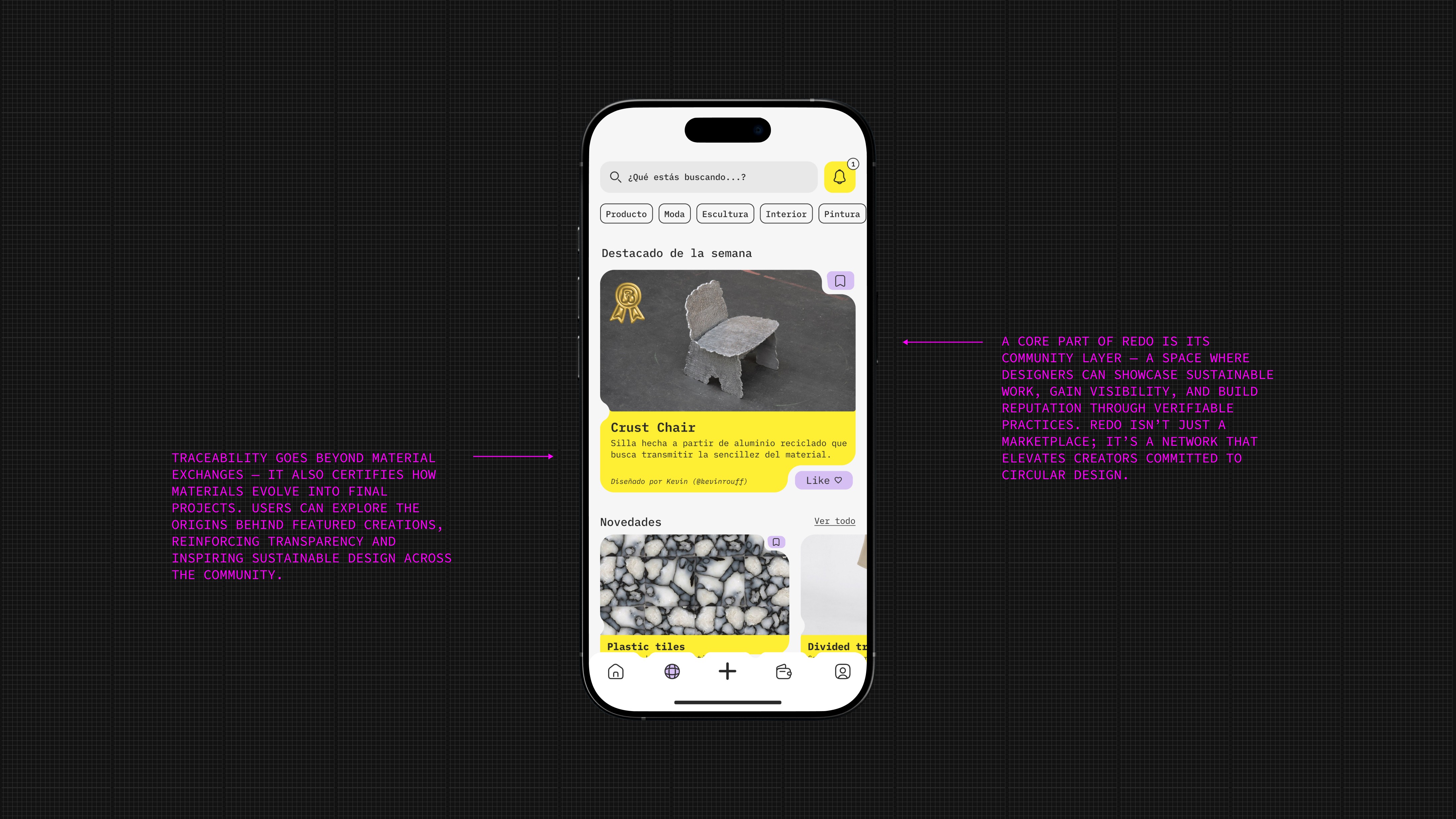
↳ This project overview page brings together Redo’s community and traceability layers: a space where designers showcase sustainable work enriched with verifiable material provenance. By linking certified materials to published projects, Re.do transforms creativity into transparent, on-chain impact — reinforcing trust, elevating responsible designers, and strengthening the circular community ecosystem.
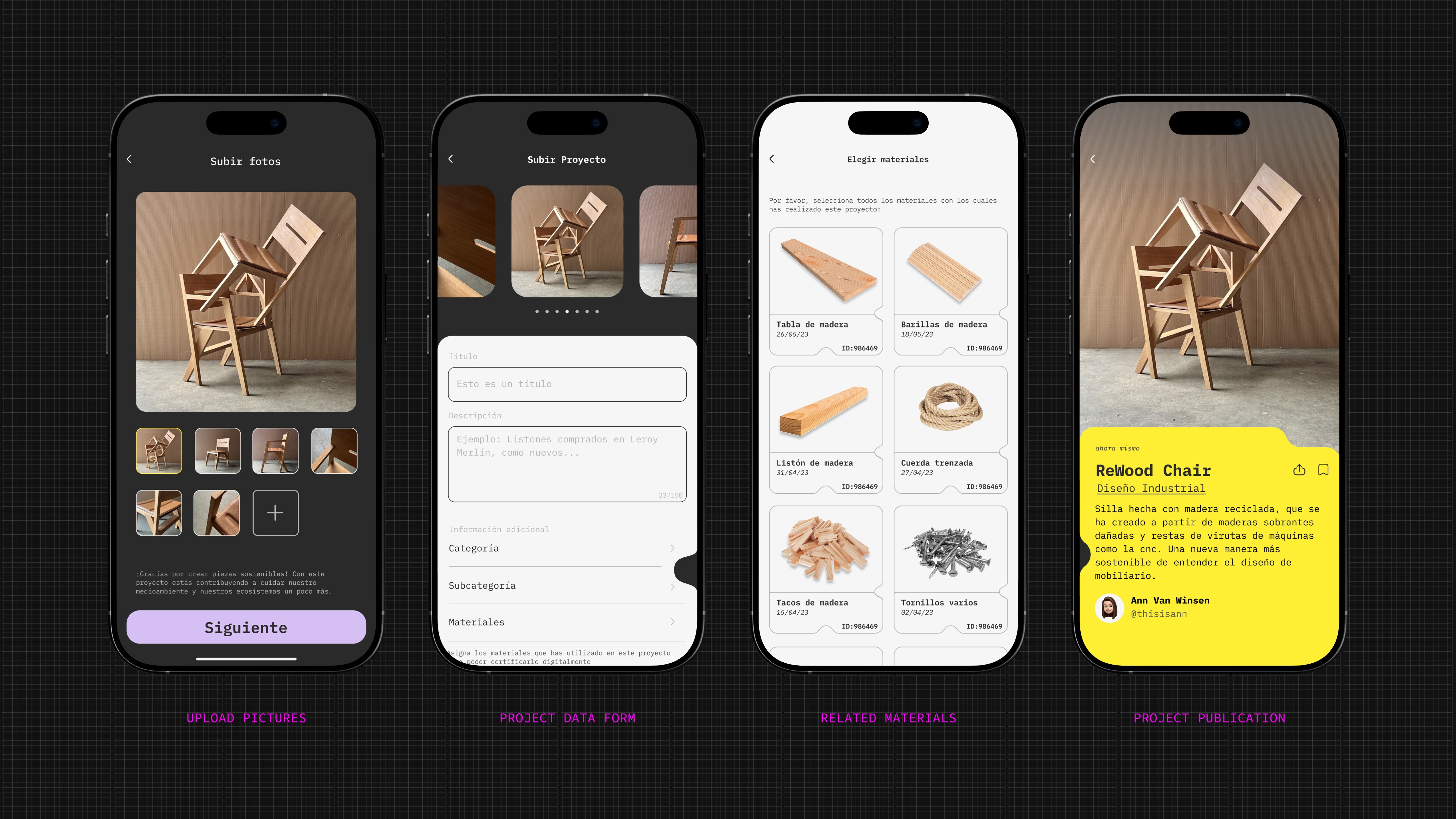
↳ Traceability in Redo extends beyond material exchange — it becomes part of how projects are created, documented and shared. Users can enrich their work by linking the certified materials they used, adding verifiable sustainable value to their projects. This turns each publication into a proof-of-impact asset, strengthening community trust, enabling transparent provenance and fostering a Web3-native culture of responsible design.
BUSINESS DRIVEN DESIGN
To validate Redo not only as a product but as a sustainable business, we designed a revenue model tightly integrated into the product architecture, the Web3 infrastructure, and the behavioral dynamics of the community.
Our goal was not just to monetize — but to ensure coherence with Re.do’s core values: circularity, transparency, and traceable ownership.
Our business model:
Collaborative economy platform based on the exchange of materials between buyers and sellers supported by Web3.
Why collaborative economy?
Adopting a collaborative economy framework allows Redo to activate peer-to-peer value creation, reduce dependency on centralized supply chains, and grow organically through user-generated materials, projects and verified data. It also reinforces trust and authenticity when combined with Web3 principles such as on-chain identity, transparent provenance and decentralized ownership.
In Redo, the community becomes part of the economic infrastructure of the product. Empowering users as contributors, validators and creators transforms the marketplace into a self-sustaining circular system where business growth and environmental impact move in the same direction.
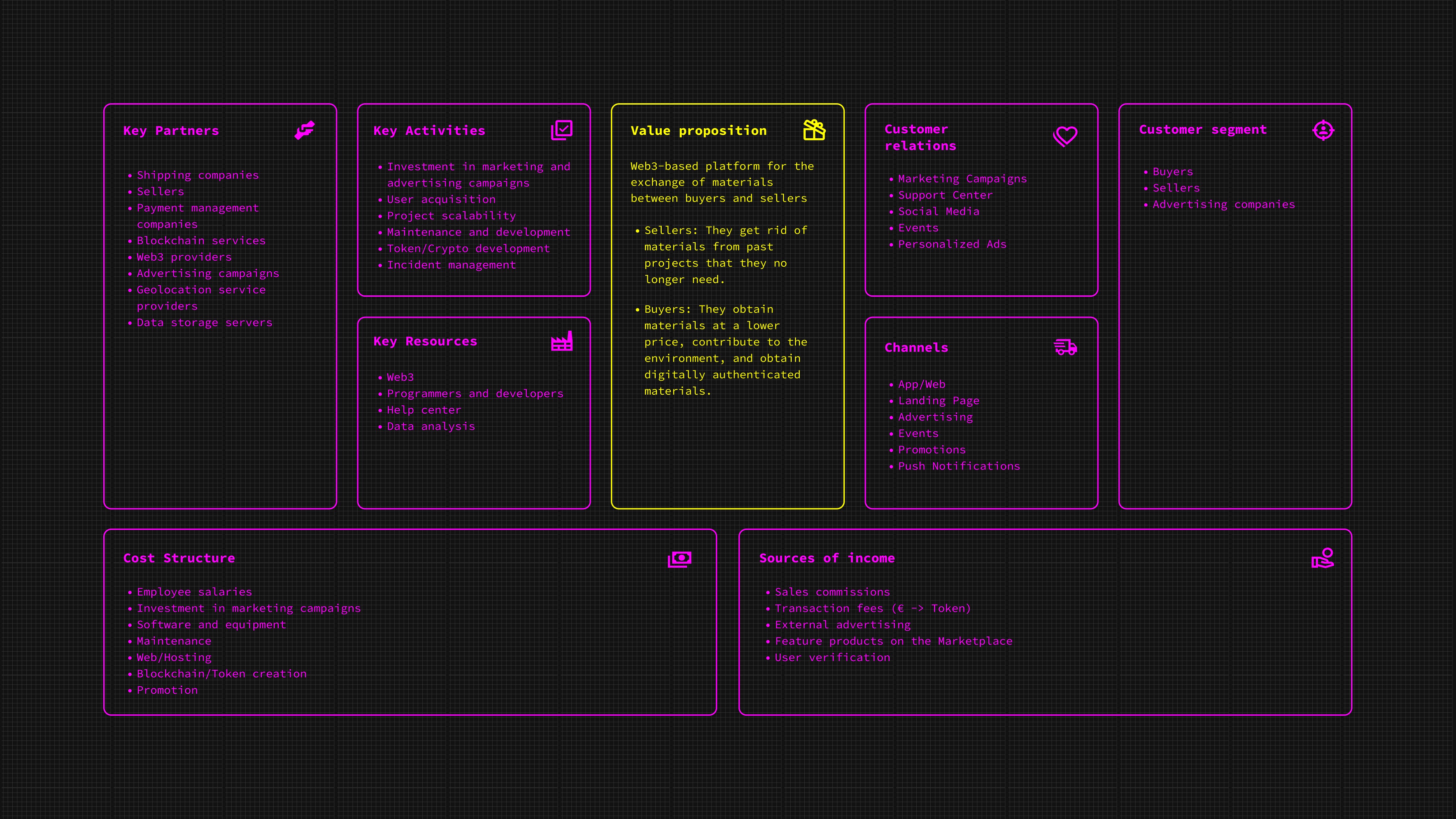
↳ To define Redo’s strategic foundation, we mapped the entire value ecosystem using a Business Model Canvas. This framework helped align product, technology and business by identifying key partners, Web3 resources, revenue streams and the operational impact of a decentralized marketplace. It allowed us to design a product that is not only technically feasible, but economically scalable and aligned with a sustainable, token-driven circular economy.
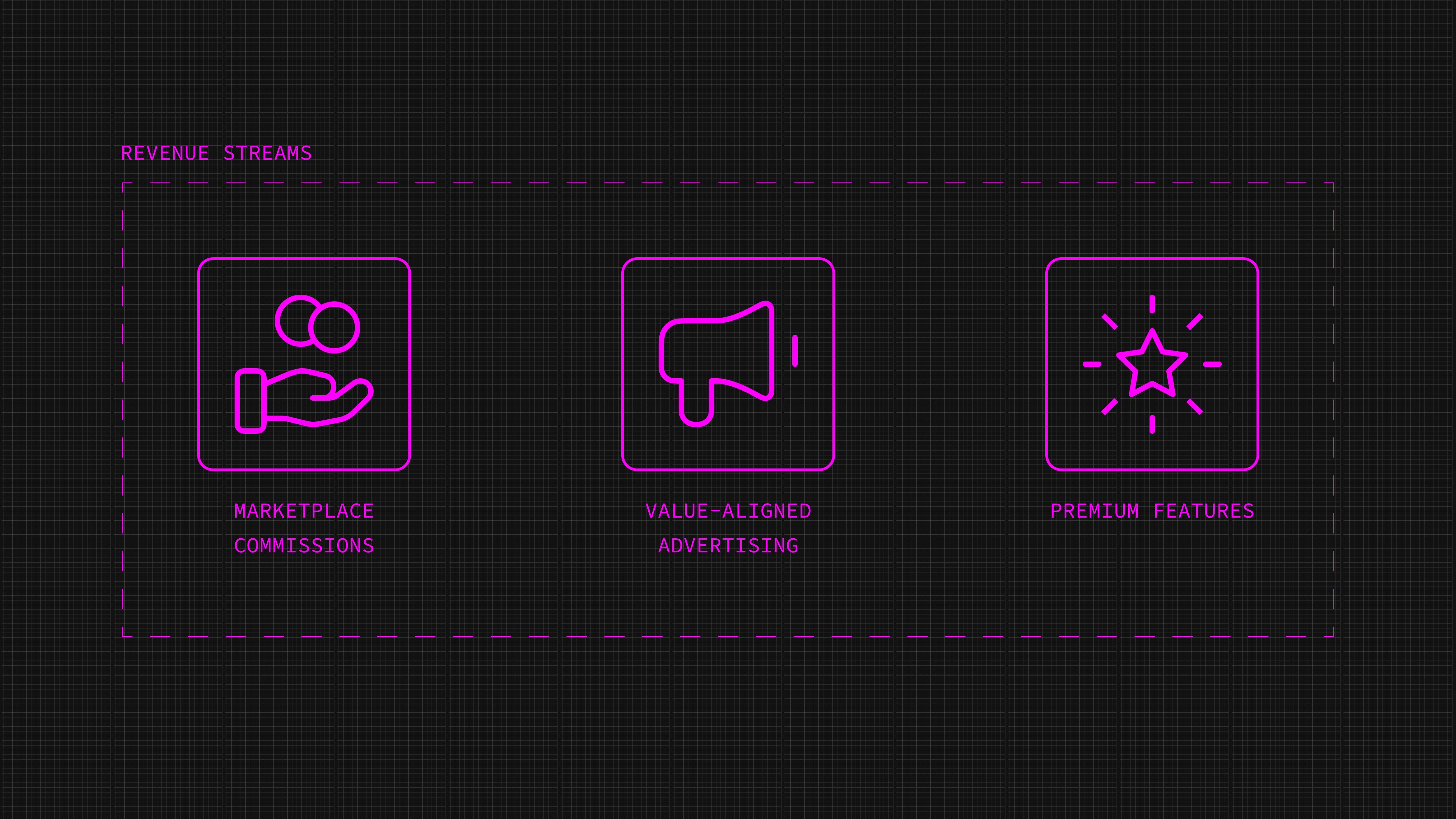
↳ Redo’s revenue model is designed as an extension of its product architecture and Web3 foundations, ensuring sustainability without compromising decentralization or community values. Our income is driven by three core pillars: marketplace commissions, which leverage r0in as the native payment layer; value-aligned advertising, curated to reinforce trust and circular-design principles; and premium features that enhance visibility, credibility and logistics for power users. Together, these streams create a scalable business model fully integrated with Redo’s mission of authenticated, transparent and community-driven circular commerce.
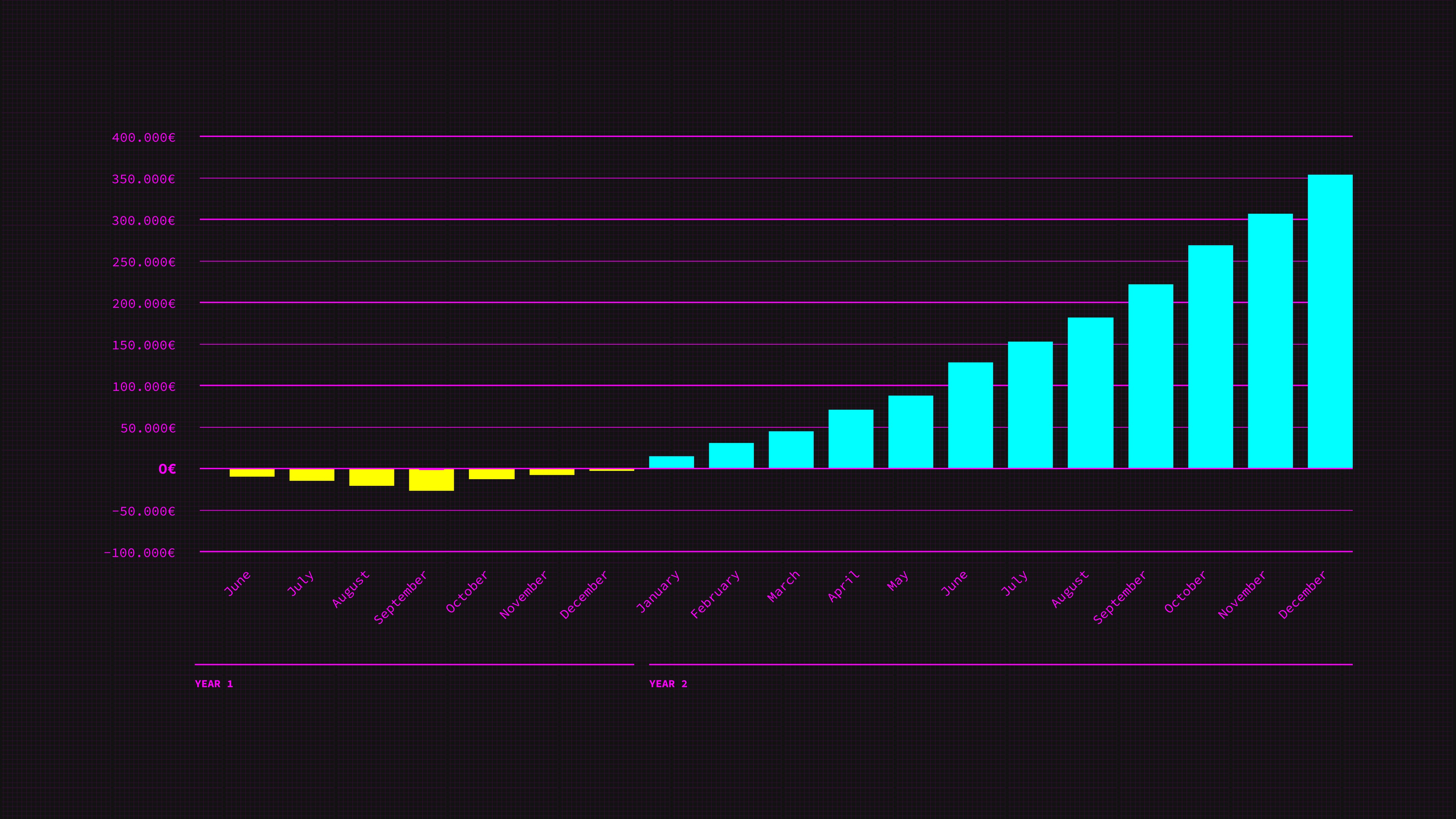
↳ This cashflow projection visualizes how Redo’s product ecosystem scales as core features mature — from traceability flows and the on-chain payment layer to community-driven project publishing. As user adoption grows, each product surface (material exchange, certification, r0in transactions and premium tooling) reinforces the others, unlocking sustainable revenue loops organically designed into the experience. The model reflects a product strategy where value creation, transparency and circular design directly translate into predictable, long-term business growth.
[05] IMPACT
The project’s presentation positioned Re.do as a proof-of-concept for transparent material flows, demonstrating how decentralization, traceability and user-centric design can coexist without sacrificing simplicity. This sparked traction across academic, professional and community environments.
Academic Adoption as a Reference in Product-System Design
Redo was used as a case study in courses related to product design, service design, systems thinking and emerging technologies, helping students understand blockchain abstraction, multi-layer architectures, and token-enabled traceability.
Professional Validation of Web3 Applied to Sustainable Design
The project attracted strong attention from external juries and industry visitors, who highlighted Redo as a rare case where Web3 is used for utility, not hype.
Personal & Professional Growth Through Complex Product Work
Redo stands as a compelling example of how design can bridge emerging technology and meaningful environmental impact, even at prototype stage.
▶
Designing multi-layer product architectures (Web3, L2 scaling, token logic, identity layers).
▶
Building trustless, verifiable workflows through user-friendly UI and clear system logic.
▶
Aligning design, business strategy and technology into a unified product narrative.
▶
Demonstrating the ability to turn deeply technical systems into accessible user experiences.
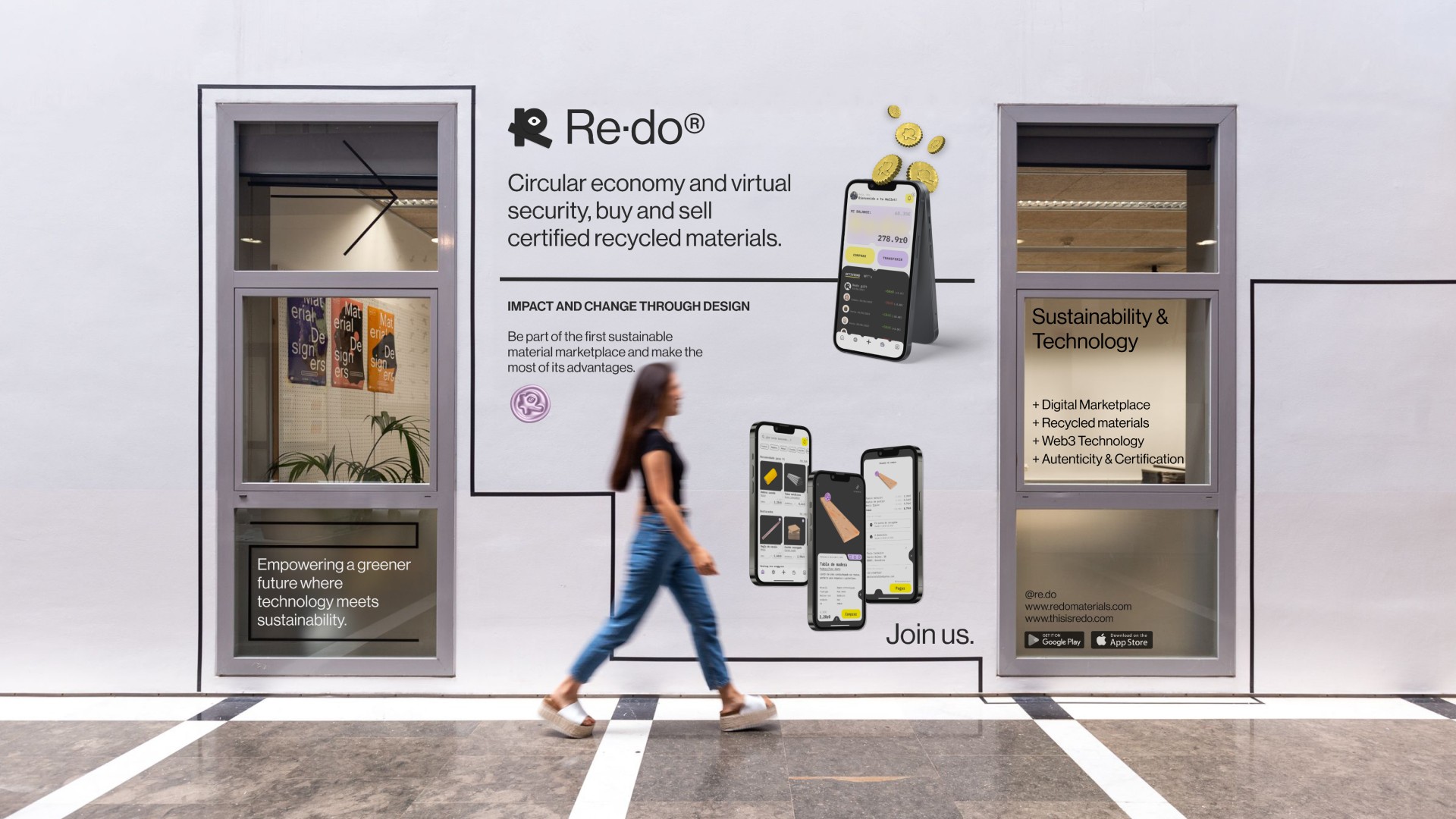
↳ Re.do generated real visibility within the university ecosystem. We installed a full-scale campaign in the main design hall to test early interest and communicate the vision of a Web3-powered circular marketplace. The activation attracted students, faculty and visitors, sparking conversations around sustainability, traceability and decentralized design systems.
[06] OUTCOME
Redo became a turning point in my approach to digital product design. It pushed me to think beyond interfaces and into full product systems: multi-layer architectures, traceability flows, decentralized identity and token-driven interactions. Working with Web3 primitives for the first time forced me to translate highly technical concepts into experiences that feel simple and intuitive — a challenge that fundamentally reshaped how I design.
The project also strengthened my understanding of product strategy and business logic. Designing a circular marketplace with sustainable revenue loops helped me connect product mechanics with long-term value creation, something that today I consider essential in any real product environment.
Redo was, in many ways, the catalyst for my interest in Web3 and emerging digital ecosystems. What started as a thesis project opened a path that continues to influence the type of products I want to build: transparent, community-driven and architected for the future.
The collaboration behind the project also shaped me as a designer. It improved my ability to align with multidisciplinary teams, frame complex decisions clearly, communicate technical ideas without friction and navigate ambiguity.
Ultimately, Redo helped me evolve from designing screens to designing ecosystems — products where technology, sustainability, community and business strategy operate together as a coherent whole. It remains one of the most formative projects of my career.
In 2024 it received a Laus Award from ADG-FAD in Barcelona, selected as one of the year’s most innovative digital-design projects. This acknowledgement validated both the concept and the level of rigor behind the design process.